
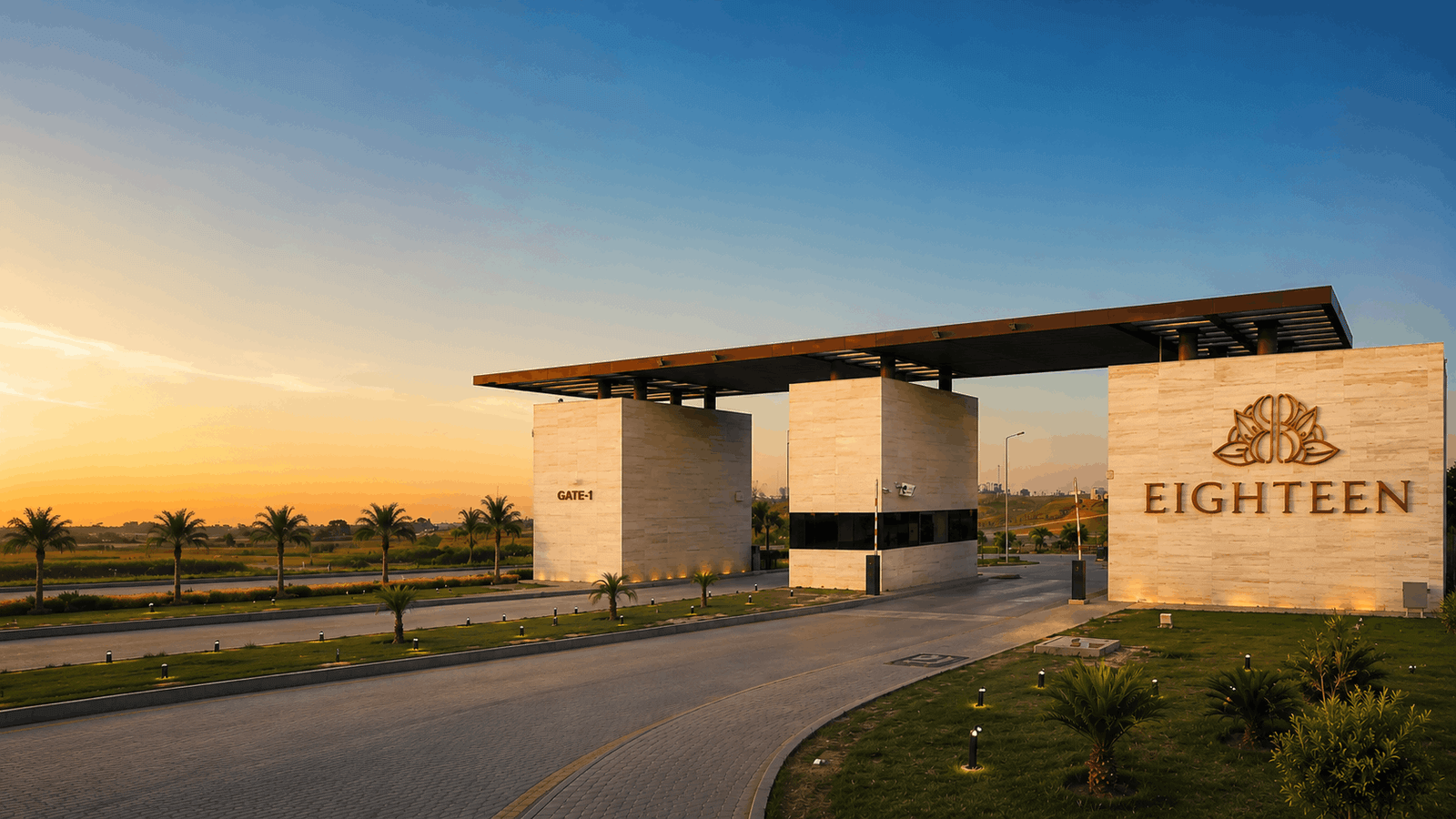
Every brochure in Islamabad’s property market promises the same short list. Security. Greenery. Backup power. A community centre.
The words cost the developer nothing. The monthly maintenance bill that follows costs you a great deal.
If you are shortlisting a home along Srinagar Highway or the Islamabad Expressway, the real question is not whether a project has facilities. It is which gated community amenities actually get used, hold their value, and show up in the resale price five years from now.
This guide separates the two categories so you can price a project on what it delivers rather than what it advertises.
Why Amenities Are Priced Into the Land, Not Added On Top

A common mistake among first-time buyers is treating amenities as a bonus layered over the plot price.
They are not. In a master-planned scheme, the cost of the golf course, the boulevard, the water treatment plant and the club is built into the per-square-yard rate from day one. It is then carried forward through recurring maintenance charges for as long as you own the property.
That has two consequences worth sitting with:
- You pay for every facility, used or not. A family that never touches the gym still funds it through monthly dues. Facilities you will not use are a permanent cost line.
- Undelivered facilities are a sunk cost. If a project charges for a lake or sports complex that is still a rendering four years later, that money is gone and the promised uplift in value has not arrived.
Evaluating luxury housing society facilities is therefore a cost-benefit exercise, not a wish list.
The Amenities That Reliably Justify Their Cost
Genuine Perimeter Security and Access Control
This is the one feature almost every resident uses daily. It is also the one most often reduced to a guard and a boom barrier.
What actually earns the premium:
- Single controlled entry with vehicle logging. Multiple unmanaged entry points make a wall decorative.
- Continuous boundary integrity. Walk or drive the full perimeter before you buy. Gaps where the wall is incomplete are common in phased developments.
- CCTV with a manned control room. Cameras that record but are never watched deliver forensic value only. Ask about footage retention periods.
- Resident and visitor identification. Sticker-based vehicle access, domestic staff registration and visitor pre-authorisation matter more day to day than gate height.
Security has the shortest path to resale value, because it is why most buyers chose a gated scheme in the first place.
Independent Utility Infrastructure
In the twin cities, utility reliability separates a house that functions from one that needs constant workarounds.
- Underground electrification. It reduces storm outages, removes overhead clutter, and is expensive to retrofit later.
- Dedicated water supply. Tube wells with filtration, overhead storage, and a distribution network you can verify. Ask about water quality testing.
- Sewerage treatment rather than open disposal. A working plant protects both the environment and the green areas irrigated with treated water.
- Gas provision status. Be direct on this one, for reasons covered below.
Get the Gas Position in Writing
Gas is where more Islamabad buyers get caught out than any other utility, and the national picture has moved repeatedly in recent years.
New domestic connections were frozen for several years, then the federal cabinet approved resumption in September 2025, with supply shifted to imported RLNG rather than local system gas.
That opening did not last. New connections were suspended again in spring 2026 on cost and supply grounds, with reports through mid-2026 suggesting the position would be reviewed as LNG availability improved.
The practical takeaway is simple. Policy here changes faster than construction timelines, so a sales-desk assurance about gas is worth very little. Confirm the current, block-specific position in writing, and budget for LPG or electric cooking as a fallback.
Road Widths, Layout and City Access
Infrastructure is unglamorous. It is also the amenity that ages best.
- Main boulevard and internal road widths. Wider carriageways preserve traffic flow as occupancy rises and protect resale appeal in the blocks behind the main spine.
- Proximity to a primary artery. Direct access to Srinagar Highway, the Islamabad Expressway or a signal-free corridor compresses commute times permanently.
- Approach road condition outside the gate. Many schemes are pristine inside and reached by a broken link road.
Location advantage is the one amenity that cannot be built later.

Usable, Maintained Green Space
Green space is the most over-promised and under-maintained category in the market.
The distinction that matters is between land marked green on a master plan and land that is actually landscaped, irrigated and open to residents.
- Functional parks with lighting and walking tracks. These get daily family use and support the case for suburban living.
- Mature planting rather than new saplings. Established trees signal years of maintenance, not months.
- A real irrigation source. Ask what waters the landscape in June. Treated water or dedicated wells suggest a plan. Tankers suggest improvisation.
Daily Convenience Retail Inside the Gate
A scheme where every carton of milk requires leaving the boundary creates friction residents feel constantly.
- Grocery, pharmacy and basic services within the community. These reduce trips and raise rental appeal for tenants without cars.
- A commercial spine that is actually leased. Empty shop fronts three years after handover indicate the population has not reached the threshold to support retail.
- Schools and clinics within a short radius. Even outside the boundary, proximity drives family demand and supports resale.
Where EIGHTEEN and Gulberg Greens Sit on This Spectrum
Two Islamabad projects show how differently a gated community amenities package can be structured for different buyers.
EIGHTEEN, Srinagar Highway
EIGHTEEN is a master-planned development on Srinagar Highway near the M1-M2 link road, adjacent to Sector H-17. It is a joint venture between Egypt’s Ora Developers, Saif Group, and Kohistan Builders and Developers.
The project is organised around an 18-hole championship golf course, with villas, apartments, a clubhouse, a retail component and a commercial business district in the master plan. Reported land area varies between roughly 572 and 700 acres depending on the source, which is itself a reason to take figures from the developer rather than third-party listings.
What the structure means for a buyer:
- The golf course is the organising principle, not a side feature. Frontage and proximity drive internal price variation. If golf matters to your household, the premium is rational. If it does not, you are still funding the most maintenance-intensive facility type there is.
- The offering is designed as an integrated lifestyle package rather than a set of separate facilities, which is the model international master-planned communities use.
- Approval detail requires care. Published sources variously reference RDA, PHATA and CDA Sector H-17 for different phases. Ask the developer which authority covers the specific phase you are buying into, and verify it yourself.
- Delivery status is the key variable. Confirm which components are complete, which are under construction, and what the contract says about each.
Gulberg Greens, Islamabad Expressway
Gulberg Greens is developed by the Intelligence Bureau Employees Cooperative Housing Society, also referred to as IBECHS Phase III, and sits on the Islamabad Expressway.
Its defining characteristic is large-format farmhouse plots in 4, 5 and 10 kanal sizes, alongside the adjacent Gulberg Residencia, which carries smaller residential plots from 5 marla to 2 kanal. The scheme was launched in the mid-2000s and holds a CDA NOC issued in 2009.
Its commercial areas include the Civic Centre, Business Square, Business Park and Blue Area, as set out in the Zameen area guide for Gulberg Greens.
What the structure means for a buyer:
- Space is the primary amenity. Value rests on plot size and private open land rather than a concentrated cluster of shared facilities. If you want room for your own pool, lawn or orchard, this is the more direct route.
- Established commercial activity. A functioning commercial base supports both convenience and rental demand, which newer schemes usually lack.
- Development stage varies by block. The scheme spans blocks A through E plus an Executive Block, with differing completion and possession status. Conditions in one block are not a reliable guide to another.
Neither model is superior in the abstract. EIGHTEEN concentrates value in shared, high-specification facilities. Gulberg Greens concentrates it in private land area.
Your household’s actual usage pattern should decide which premium you pay.

Amenities That Rarely Justify Their Cost
Being candid here is more useful than a longer list of positives.
- Themed replicas and monuments. Statues, arches and imitation landmarks add maintenance liability and no measurable resale value.
- Oversized clubhouses in under-occupied schemes. A large facility at fifteen percent occupancy is carried by few residents, which drives up dues or produces visible neglect.
- Ornamental water bodies with no maintenance plan. Decorative lakes become a negative feature the moment they stop being clean.
- Facilities announced with no allocated land. If it does not appear on an approved layout plan with a marked parcel, treat it as marketing.
- Duplicated sports facilities. Three tennis courts in a scheme where a dozen residents play is a cost centre dressed as a feature.
A Practical Checklist Before You Commit
Use this as a site-visit script, not a reading exercise.
- Approval status. Check the scheme and the specific phase on the CDA housing schemes portal, or with RDA for schemes under Rawalpindi jurisdiction. CDA grants approval in two steps, layout plan first and NOC second, so confirm which stage your phase has reached.
- Current versus planned. Ask the developer to mark what is complete today on the master plan. Photograph it.
- Maintenance charges in writing. Get the current figure, the escalation mechanism, and what it covers. Then ask what it was three years ago.
- Occupancy rate. Count occupied homes during an evening visit. Lit windows tell you more than a presentation.
- Resident opinion. Speak to two or three residents at the park or the shops. Fastest accuracy check available.
- Utility reality. Confirm electricity, water, gas and sewerage for your block, not the scheme overall.
- Transfer process. Verify procedure, charges, and any restrictions on resale before possession.
Frequently Asked Questions
Which gated community amenities most affect resale value in Islamabad?
Security infrastructure, developed and lit roads, verified utility connections, and position relative to Srinagar Highway or the Islamabad Expressway have the clearest effect. Decorative features have the least.
Are golf course communities a good investment in Pakistan?
They can be, but the premium concentrates in course-facing plots and depends on the course being completed and professionally maintained. Buyers who do not play should assess whether they are funding something they will never use.
How much are maintenance charges in a gated community?
They vary widely by scheme, plot size and facility load, and there is no reliable market-wide figure. Request the current schedule in writing from the management of the specific project, plus its increase history.
Is a farmhouse plot better than an apartment in a serviced community?
They serve different needs. Farmhouse plots offer private land and development freedom with more owner responsibility. Serviced communities offer managed facilities and less personal upkeep, at the cost of ongoing dues and less control.
Can I get a sui gas connection in a new Islamabad housing scheme?
It depends on national policy at the time and whether the scheme has an operational RLNG network. The position has changed several times between 2021 and 2026, so confirm the live status with the developer and the relevant gas utility rather than relying on a brochure.
What is the biggest mistake buyers make when comparing facilities?
Comparing brochures instead of comparing sites. A visit at two different times of day, including an evening, reveals occupancy, staffing, lighting and traffic in a way no document can.
Should I buy before construction is complete?
Early entry prices are lower but carry delivery risk. Tie payments to construction milestones where possible, and confirm what recourse exists if timelines slip.
The Bottom Line
The features worth paying for are the ones you touch every day. A gate that is genuinely controlled. Power and water you can rely on. Roads that carry traffic properly. Green space that is actually maintained. Shops within reach.
Everything beyond that is lifestyle preference, and lifestyle preference should be bought deliberately rather than absorbed into a price you never questioned.
EIGHTEEN and Gulberg Greens sit at different points on that spectrum, one built around an integrated facility-led model and the other around private land area with an established commercial base. Both are legitimate.
The discipline that protects your money is the same either way. Verify what exists today, get the maintenance cost in writing, and price gated community amenities according to what your household will realistically use over the next decade rather than what looks best on a site plan.
Join The Discussion